"Every man, wherever he goes, is encompassed by a cloud of comforting convictions, which move with him like flies on a summer day."
— Bertrand Russell

The Sign You Didn't Notice
You stop at a red octagon dozens of times a week without once asking why it works. It's not the color. It's not the shape. It works because you and every other driver inherited the same agreement about what it means.
Ferdinand de Saussure called this the relationship between signifier and signified. The physical form of a sign and the concept it points to. That relationship is not merely natural. It's normative and occasionally arbitrary.
This is the domain of semiotics: the study of how signs produce meaning.

Saussure gave us a powerful starting point, but his model assumes meaning is stable once the convention is learned. You learn the sign, you get the meaning. Done.
Charles Sanders Peirce corrected this with a third element: the interpretant. Not the sign. Not the object. The mental response that a specific mind produces when it encounters the sign. This reframes the problem. Meaning is not transmitted like bits from sender to receiver. It is constructed, uniquely, inside each person who encounters the sign. The same word lands differently depending on the reader's experience, context, and intent.
This is not a flaw in language. It is how signification actually works.
Umberto Eco extended Peirce's insight further. Each interpreter doesn't just bring a single mental response. They bring an entire encyclopedia of knowledge, culture, and professional history to every sign they encounter. Eco called this encyclopedic competence. Two people can share a language and still decode the same sign through incompatible knowledge systems.

This sensitive dependence on initial conditions warps each of our little windows-to-the-world in a fingerprinted way. Every experience, every prior encounter with a sign, becomes a frozen interpretive commitment that shapes how the next sign gets decoded.
In a previous article, "Words are Vague," we explored how a single word like "set" can point to over 430 meanings. Semiotics tells us why: the sign was never carrying the meaning in the first place.
When Organizations Speak in Symbols
Every organization is a dense semiotic environment, whether it recognizes itself as one or not.
Corporate language is full of signs that feel shared: "agile," "alignment," "digital transformation," "customer-centric." These terms circulate through meetings, decks, and strategy documents as though everyone agrees on what they mean.
I will spill an open secret. They do not.
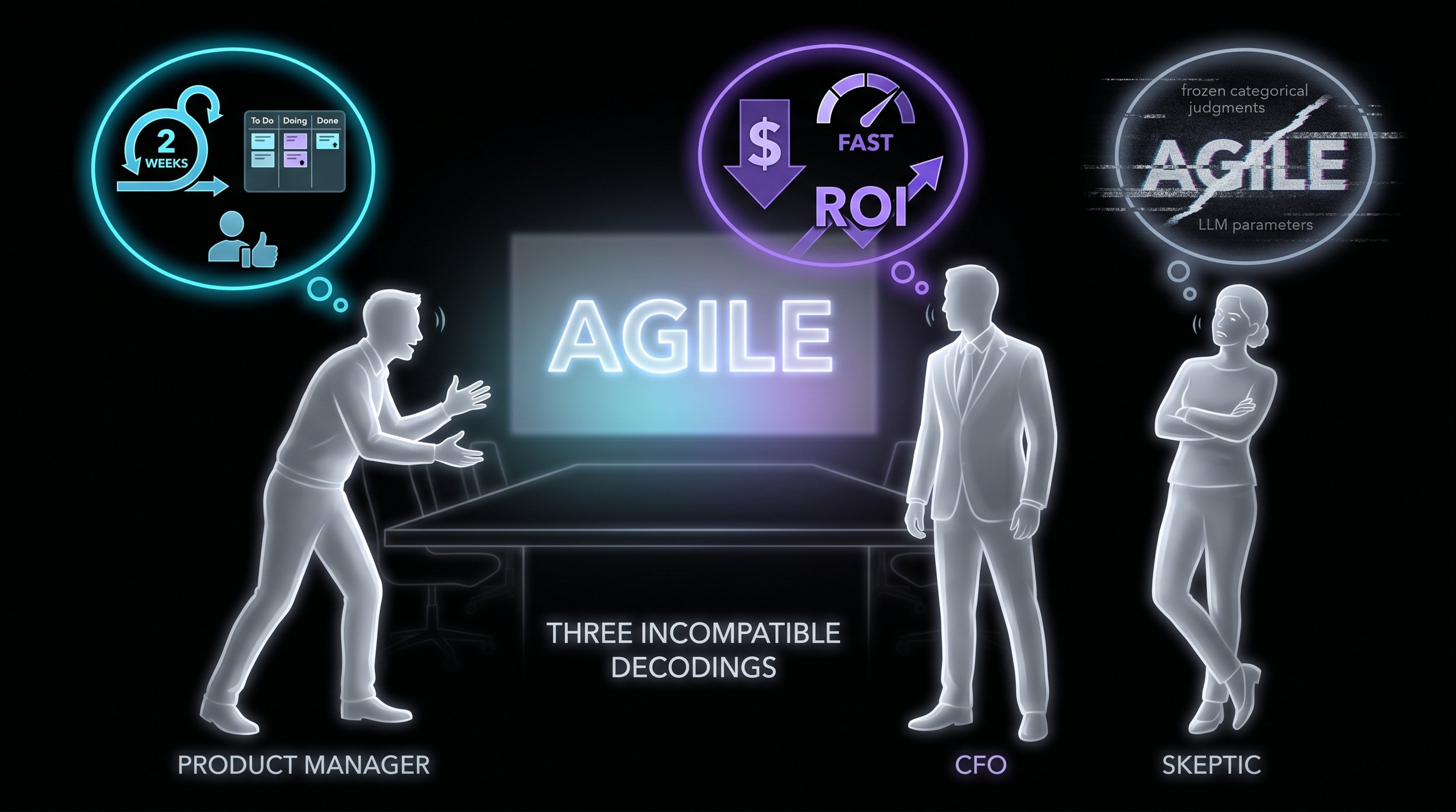
This is not incidental misunderstanding. Eco called this phenomenon aberrant decoding. The receiver's cultural framework is so different from the sender's that the message gets decoded in an unintended way. (Maybe you remember Yao Ming discussing his use of "um" in the locker room)
A product manager hears "agile" and draws on a repertoire of sprint rituals, iterative delivery, and user feedback loops to breathe a sigh of relief that we have a real process. A CFO hears "agile" and imagines lean operations, reduced overhead, and faster ROI. I hear "agile" and I get a little salty. Corporate jargon like "agile" has frozen categorical judgments baked in, just like LLM parameters. Each person is decoding through a different encyclopedic competence.
People nod in agreement in the same meeting and leave with entirely different understandings of what was decided. The fracture is systemic, not incidental.
The Cognitive Cost of Assumed Meaning
When aberrant decoding happens systematically, decision-making degrades in ways that are difficult to trace. People act on their own constructed meaning, their own interpretant, not on a shared one. You assume the junior wasn't listening. Maybe they listened carefully without a framework for what matters to you.
Consider two directors who leave a leadership meeting having agreed to "move fast." One cuts approval processes to reduce friction. The other adds headcount to increase throughput. Neither is necessarily wrong. They decoded the same sign through different cognitive frames.
This kind of divergence compounds over time into strategic drift. Teams pulling in directions that feel aligned but are not. New signals are shoehorned into whichever frame was already running. The interpretation skips the update phase. It absorbs the next smudge and semantic overload is well underway. Leadership typically diagnoses this as misalignment or poor execution. The real issue is upstream at the symbolic level.

Organizations don't have a communication problem. They have an encyclopedic competence problem: people decoding the same signs through incompatible knowledge systems. The meaning was never synchronized. It was only assumed.
The angsty gap is filled with interpretive debt.
Negotiated Overcoding: Making Meaning on Purpose
The instinct, when semiotic fractures become visible, is to write more definitions. But a glossary is just more signs. It doesn't close the interpretive gap. It adds another layer to it.
Remember Schrodinger's ipad a few weeks ago? This is the LLM abstraction problem at the human level.

Eco's concept of overcoding points to what actually works: cultural conventions that make certain interpretations nearly automatic. Shared rules that narrow the interpretive field. The fix is not eliminating ambiguity. That's impossible. The fix is negotiating which interpretations are plausible.
Process mapping is one tool for this. It externalizes how people actually decode the signs an organization produces, revealing where encyclopedic competences diverge. Structured dialogue is another. This is not conversation for its own sake, but deliberate exercises that force individual interpretations into the open.
Companies love to try the second option, but it generally ends with a pat on the back for HR and a chilling effect on any conversations that would surface private meaning.
To be productive, organizations need to ensure that the assumed interpretive rules are made explicit.
Organizations that transmit meaning from the top treat leadership language as System 0 preprocessing. Organizations that negotiate meaning treat it as System 3 scaffolding. They think better and they stop waiting for a paternal LLM to tell them what to do.
Stay tuned for our next issue in this short series on abstraction, meaning-making and LLM's.